
By Zou Nani,Reporter of Hunan Daily; Correspondent Peng Shiqi
Originally published in Hunan Daily, Page 06, June 26, 2026
On the production floor of Gonvvama (Loudi) , the number on the safety bulletin is updated daily: as of June 24, 2026, the factory has accumulated 3,621 consecutive days of safe production.
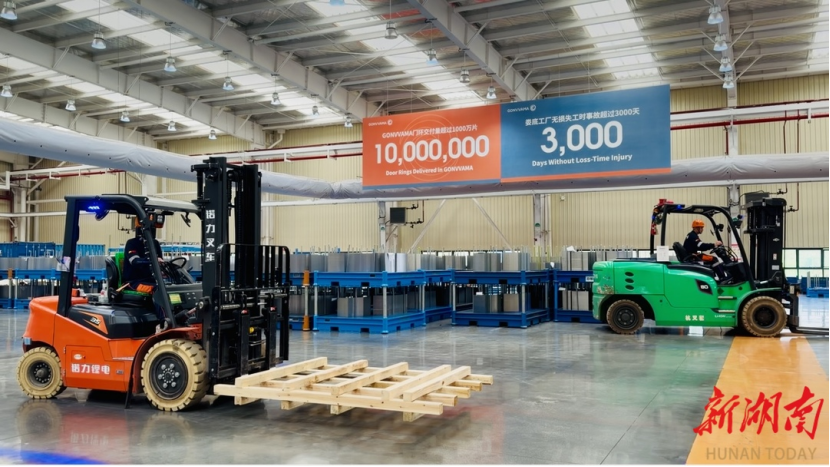
( Gonvvama Loudi Factory has achieved over 3,000 days of safe production)
This factory is a joint venture between Gonvarri and VAMA. It features internationally leading laser welding lines, laser ablation lines, laser cutting lines, and a 1,250-ton blanking line, with an annual capacity of 80,000 tons of lightweight automotive steel and 3 million laser-welded blanks. However, these operations also bring potential safety risks including vehicle accidents, lifting injuries, object strikes, sharp edge cuts, entanglement and crushing hazards, and noise-induced hearing loss.
As a Sino-foreign joint venture, how has the factory woven such a tight safety net to achieve nearly 10 years without lost-time accidents and zero occupational disease cases? Recently, our reporter visited the plant in Loudi to explore the management logic behind this achievement.
I. Physical Barriers: Caging the Risks
Walking into the production workshop, the roar of machinery fills the air. A 150-meter-long blanking line stretches out in a straight line, and what catches the eye is the 400-meter-long transparent physical fence surrounding it. This seemingly simple barrier completely separates people from high-speed operating equipment.
It is not just about fencing off the area. The reporter observed more than 20 safety gates on the fence, and every employee has a personal safety lock. If someone needs to enter the production line for maintenance, they must first lock the start switch. This ensures that when someone is working inside the line, the production line cannot be started, guaranteeing the safety of personnel inside. When equipment is running, if any safety gate is opened, the entire production line stops instantly to prevent personnel from being injured by moving parts.
Addressing the pain point that steel plate edges become extremely sharp after laser cutting, which can easily cause "sharp edge cuts", the factory has invested heavily in material flow processes. In the robotic arm picking workshop, light curtains at the entrance use infrared sensors—if any person enters the working radius by mistake, the robotic arm immediately makes an "emergency stop". On logistics routes, all forklifts transporting steel are speed-limited to under 10 kilometers per hour.
The reporter noticed that forklifts project a 3-meter-wide blue light circle when driving. "This is our '3-meter blue light' protection system. Once personnel approach the dangerous distance, the forklift stops immediately," introduced Paul Deng, head of the EHS (Environment, Health and Safety) Department. These intrinsic safety measures form the first line of defense to eliminate "human error" at the source.
Production safety focuses on source prevention. The company has done thorough work in three aspects: equipment modification, on-site protection, and daily training, eliminating accident possibilities through hardware.
Before taking up their posts, every new employee's first task is not to shadow on the production line, but to complete a 3-day systematic safety production course. They fully learn the factory-wide safety management system, risk points of the four major processes, standardized use of personal protective equipment, operation of various emergency equipment, and hazard reporting procedures. Only after passing the assessment can they start working.
II. Mechanism Building: Practical Plans for 29 Scenarios
Hardware protection is only the first line of defense; refined software management builds the second. At Gonvvama Loudi Factory, the refinement of safety production is reflected in a detailed "Emergency On-site Response Plan Summary".
On the summary, 29 emergency scenarios cover everything from electric shock, chemical leaks, and confined space operations to typhoons, heavy snow, and even cyber attacks. Each scenario clearly identifies specific responsible persons, rather than vague "relevant departments".
"For example, if the rooftop photovoltaic inverter catches fire, we will immediately notify the main control room to cut power, then photovoltaic maintenance personnel will enter to extinguish the fire; for lubricating oil leaks, we not only practice how to stop the leak but also how to prevent it from flowing into sewers and causing environmental pollution accidents," Paul Deng explained. To support these 29 scenarios, the company has established 19 procedure documents and 107 safety operation guidelines, forming a tight institutional closed loop.
This "practical combat" orientation is particularly evident in emergency drills. In the 2025 annual drill, the factory simulated a scenario where "someone fainted in an outdoor sewer well". This subject was not imagined out of thin air—it was based on a shallow pool asphyxiation accident that occurred at a Sichuan winery in September that year. The company drew lessons from the case and specifically strengthened standardized procedures for down hole rescue. After the drill, instead of indulging in self-praise for a "complete success", the team calmly reviewed specific issues such as "leak-stopping tools not stored in obvious locations" and "employees unfamiliar with wearing special protective equipment", and immediately made corrections.
With rules and regulations to follow, daily safety inspections have formed a fixed mechanism. From front-line operators to the factory director, personnel at different levels hold dedicated safety inspection checklists, conducting full-coverage inspections of nine core production lines according to annual plans; all entry and exit of personnel, vehicles, and steel coil materials in the factory area are registered and supervised throughout the process, isolating external safety risks from the factory entrance.
III. Cultural Infiltration: From Management "Bearing the Burden" to All Employees "Blowing the Whistle"
On June 20, Zeng Jianghui, day shift production foreman, discovered during inspection that steel waste from the cutting machine dumped by the previous shift had not been transported to the designated fenced area in time and was scattered on the passage, posing a cutting risk to personnel. He immediately reported it through RAIA, and the team cleaned it up before getting off work. This "snap and fix immediately" approach has become the norm.
RAIA—the Report on Accidents, Incidents and Anomalies system—has been used proficiently at Gonvvama Loudi Factory for over 8 years. Through this system, the main body of hazard inspection has shifted from management to all employees. Every quarter, employees who excel in hazard reporting and advanced individuals in safety production are commended and rewarded, with safety performance directly linked to promotion and performance reviews.
However, this atmosphere of full participation did not happen overnight. Loading worker Liu Xubo has deep feelings about this. "At first, I thought everyone reporting risks was making a mountain out of a molehill—who would stare at those trivial things every day?" Liu admitted. As colleagues around him continued to eliminate hazards by reporting risks, he gradually realized that these seemingly trivial "whistleblowing" reports genuinely prevented coworkers from getting injured. Once his thinking changed, action followed. Since the beginning of this year, Liu has proactively reported 18 safety hazards personally.
"The shareholders has centuries of industrial heritage, and they passed on a core cultural concept to us: the highest state of safety management is not relying on safety officers to discover risks, but relying on every employee to feed risks back," Paul Deng reflected. From "wanting me to be safe" to "I want to be safe", this awakening of ownership consciousness is the most effective firewall against safety production accidents.
"Our core production lines combine multiple risks including heavy stamping, high-temperature laser processing, and steel plate transfer. Ten consecutive years without accidents is no accident—it is the result of embedding safety into every process of laser welding, ablation, cutting, and blanking, and relying on all employees to guard together," introduced Brian Yi, Plant Manager of Gonvvama Loudi Factory. The core of the enterprise's long-term adherence to safety bottom line lies in three points: first, drawing safety red lines through standardized systems to ensure everything follows rules; second, promoting intrinsic safety transformation to reduce human error risks through hardware facilities; third, cultivating a company-wide safety culture so that proactively inspecting hazards becomes conscious behavior for employees.
Relying on its sound safety management system, the company has won numerous honors including National Green Factory, National Specialized and Sophisticated "Little Giant" Enterprise, and Hunan Provincial Green Manufacturing Demonstration Unit. Its products supply mainstream domestic and international automakers such as Xiaomi, Toyota, and Volkswagen. From January to April 2026, revenue and taxes increased by 22% and 43% year-on-year respectively, with a safe and stable production environment escorting the company's continuous growth.
Since the factory was built, Loudi City and the Economic Development Zone Management Committee have attached great importance to Gonvvama's safety production. Emergency management departments frequently share excellent safety management practices from other enterprises and promptly urge the company to implement special safety production rectifications. Currently, the enterprise has a complete dual prevention system of risk hierarchical control and hazard inspection and governance, steadily realizing a virtuous cycle of positive government-enterprise interaction and joint safety management.
